The Path to the Agile Lab: Why Traditional EBR Systems Are Slowing Down the Pharmaceutical Industry—and How to Break Free
Categories
Why do recipe changes in your production still take months? While the market demands agility, rigid EBR systems slow down innovation. Discover how to break free from the "golden cage"—from paper chaos through digital bottlenecks to true production agility in hours instead of quarters.
The pharmaceutical industry thrives on a fundamental contradiction: the market demands rapid innovation and fast delivery times, while regulatory requirements (GxP, FDA, etc.) demand absolute precision and zero tolerance for errors. Many companies have tried to master this balancing act with digital tools—only to fall into a new trap.
This article shows the way out of this dilemma—from the shackles of the past to true agility in production.
Executive Summary
- Problem: Monolithic EBR/MES platforms slow change & validation cycles.
- Impact: Innovation drag, higher cost, vendor lock.
- Solution: Word-native, delta-driven digitization with embedded compliance.
- Outcome: Reduce recipe change time from months to hours.
Yesterday: The Era of Paper
Remember? Manufacturing processes were documented in thick binders. Every change required a manual, paper-based process validated with physical signatures.
The Impact:
- Extremely slow: Changes took weeks or months.
- Prone to errors: Manual transcriptions were a constant source of compliance risks.
- Opaque: Finding specific data for audits or analysis was a nightmare.
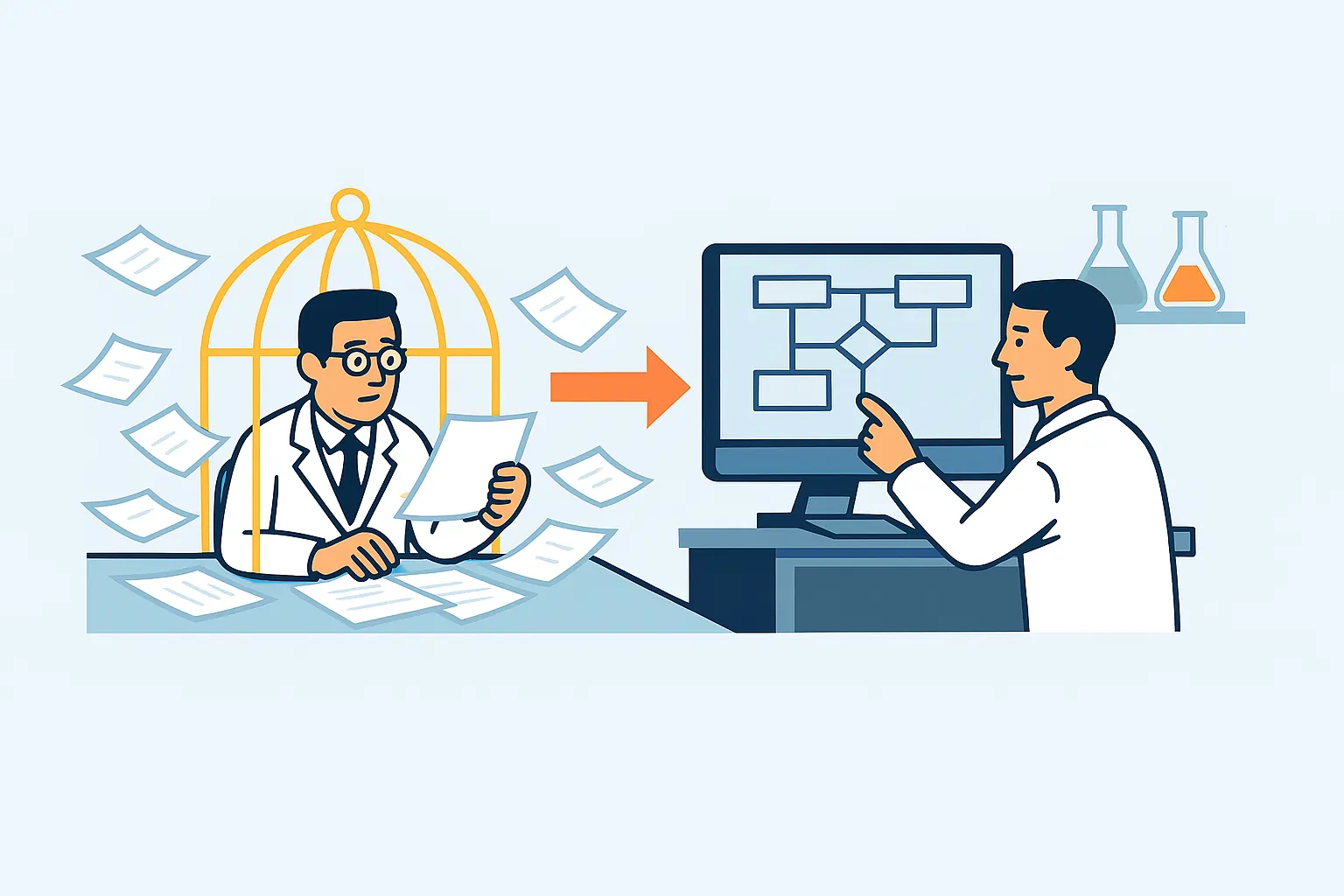
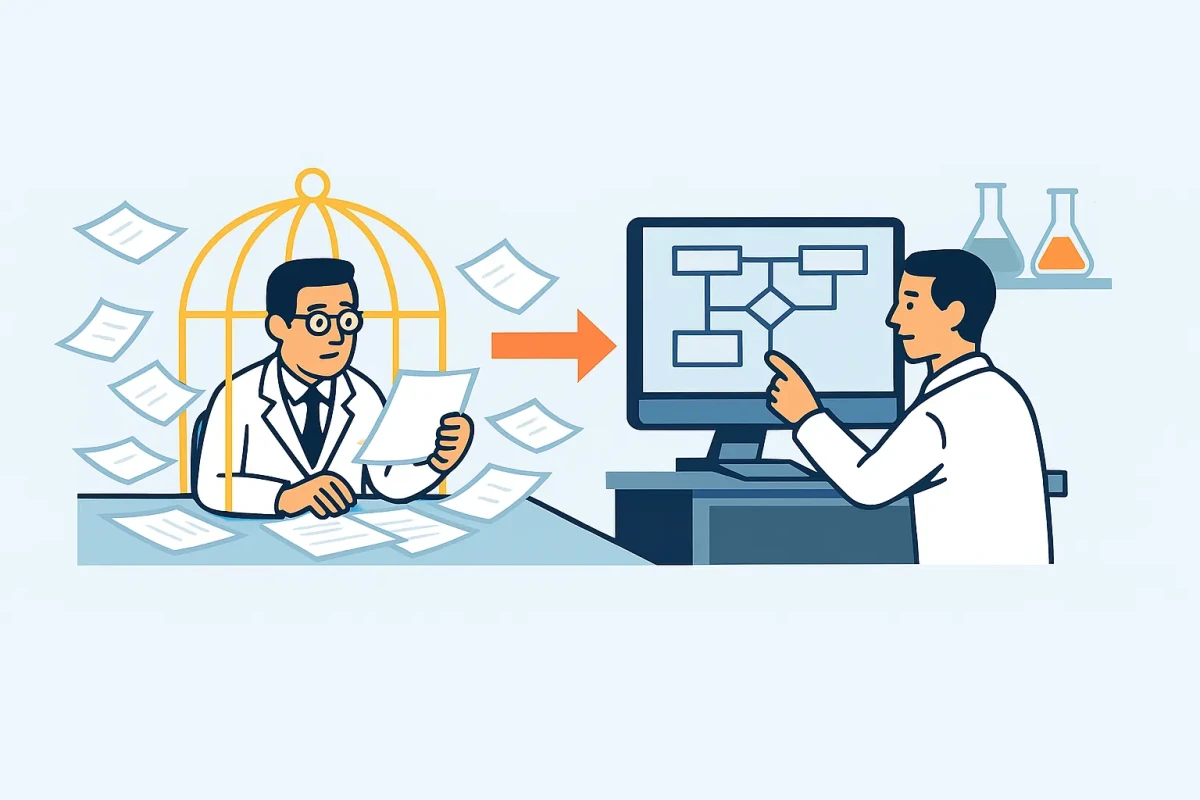
Today: The Digital Compromise—Trapped in a Golden Cage
To escape the paper chaos, many companies invested in large, monolithic EBR and MES systems. The idea was good, but the reality created a new problem: the digital bottleneck.
These systems are often a "golden cage": they offer digital documentation, but at a high price.
The Hidden Costs of Rigid EBR Systems
- Inflexibility: Even the smallest adjustment to a recipe or workflow requires expensive external specialists and takes months. The system dictates the process, not the other way around.
- Dependency: You are tied to one vendor and their complex technology. Without their experts, production comes to a standstill.
- High operating costs: License fees, maintenance contracts, and the costs of external consultants add up to enormous sums.
- Delayed innovation: The system's inertia slows down your product development and prevents a quick response to market changes.
Basically, the paper problem was just digitized. The shackles have remained; they have only become more expensive.
How long did your last recipe change take? Request 15‑min benchmark
Tomorrow: The Agile, Connected Lab with anicomply
The future does not belong to cumbersome all-in-one monoliths, but to lightweight, flexible, and connected systems that adapt to your processes.
Imagine if you could:
- Create and validate recipes in minutes instead of months?
- Use your existing Word documents as a basis for digital, GxP-compliant workflows?
- Make adjustments yourself without being dependent on external developers?
This is precisely the vision we have realized with anicomply.
What is anicomply? anicomply is a lightweight, GxP-compliant electronic batch record platform that converts existing Word-based recipe documents into digital, auditable production workflows in minutes.
How anicomply Breaks the Chains
anicomply is not another rigid MES. It is an agile EBR system based on three core principles:
- Simplicity: Use Microsoft Word®—a tool your employees already know and master.
- Speed: A new workflow is digitized and ready for validation in under two hours. This is not a theory, but proven practice.
- Integrated Compliance: GxP, 21 CFR Part 11, audit trails, and versioning are not add-ons but the core of the system. You meet the highest regulatory requirements without losing flexibility.
Frequently Asked Questions
Change remains slow & costly; anicomply targets only the bottleneck slice.
Minimal – Word stays the primary authoring surface.
Yes – audit trail, versioning, signatures are native.
Conclusion: Liberate Your Production
Digitalization in the pharmaceutical industry must not be a compromise between speed and compliance. It is time to break free from the rigid systems of the "Today" phase and take the step into an agile future.
Modern, lightweight tools like anicomply give you back control and finally enable you to be as fast and innovative as the market demands—without ever losing sight of compliance.
Are you ready for the next step? Contact us for a live demo!