
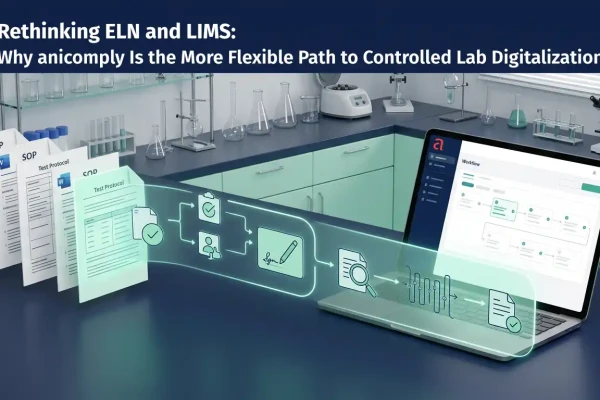
Rethinking ELN and LIMS: Why anicomply Is the More Flexible Path to Controlled Lab Digitalization
Laboratory managers, IT business partners and technical management know the problem: the SOP is stored in Word, execution happens on paper or in …

When batch documentation is still paper-based or changes in existing eBR and MES structures take too long, an operational and regulatory bottleneck emerges. anicomply helps pharmaceutical manufacturers, CMOs and CDMOs transform existing SOPs and Word-based manufacturing instructions into executable, validatable eBR workflows in record time: when processes, reviews and test basis are prepared, a fully validatable pilot can be up and running within just two weeks! This makes digitization usable faster without losing regulatory robustness.
anicomply turns manufacturing complexity into a digital, manageable process – as eBR software for modern pharma production.
CDMOs/CMOs must not only manufacture but also ensure seamless, near real-time data exchange with clients. As a result, technological capabilities, modern interfaces, and digital data transfer are becoming increasingly important.
We bring the workflow to where the content already lives – instead of imposing a new modeling paradigm.
Regulatory bodies like EMA and FDA are increasingly demanding the digitalization of manufacturing processes.
The goal is higher product quality, better data integrity, and complete traceability.
Rapid scaling, lower investment risks, higher resilience with anicomply
Why traditional systems slow you down and how anicomply shortens the entry
The struggle with paper
Focused entry with anicomply
Imagine a world where you create and release new, validated recipes in minutes instead of weeks.
anicomply is the lightweight, agile eBR system that meets the requirements of Industry 4.0:
Existing Word and SOP structures are used rather than re-modeling processes from scratch.
Early visible operational usability replaces long lead times without clear added value.
Changes remain regulatory robust and manageable from a project perspective.
Companies can start specifically with batch documentation and expand later.
| Criterion (semantic keywords) | Classic MES (eBR‑module) | Generic Low‑Code App Builder | anicomply (Word‑native eBR‑platform) |
|---|---|---|---|
| Change cycle time (recipe change speed) | Weeks–Months | Days–Weeks | Within one day for workflow conversion |
| Modeling effort (workflow authoring) | Specialist training & vendor scripting | Abstract visual modeling canvas | Familiar Microsoft Word® document structuring |
| Audit trail & 21 CFR Part 11 | Partially add-on / fragmented | Limited / custom scripts | Native audit trail + electronic signatures |
| Vendor lock / portability | High (proprietary data model) | Medium | Low – existing Word-based source assets remain usable |
| Domain autonomy (domain-driven changes) | Low (external specialists) | Medium | High – changes remain domain-driven and quickly implementable |
| Validation overhead (cycle reduction potential) | High (rebuild & regression) | Medium | Reduced – focused eBR entry with manageable scope |
| GxP compliance alignment | Broad, but cumbersome rollout | Generic, requires customization | Pre-shaped for GxP / Part 11 from the start |
| Learning curve (time to productivity) | Long (training cycles) | Medium | Short – leverages existing Word skills |
| Total Cost of Ownership (TCO drivers) | Licenses + customization services | Platform + internal configuration time | Less modeling and change effort with early time-to-value |
| Upgrade friction (version changes) | High (dependency cascade) | Medium | Low – focused eBR layer instead of monolithic expansion |
Pharma 4.0 is fundamentally transforming production: smaller batches, faster adaptation to market needs, and a variety of products on a single line. With anicomply, the breakthrough was achieved: processes were digitized in compliance with GxP, compliance was ensured, and at the same time an economically tangible entry into eBR was created.
Audit trail, versioning, electronic signatures and traceable approval processes are core features. This enables anicomply to support use in GxP-regulated environments while keeping the change and validation effort within a manageable scope.
anicomply is primarily an eBR-first solution for digital batch documentation and workflow-driven process execution. For companies that primarily need a robust eBR, this can already cover the central requirement. In more complex environments, anicomply can be integrated into existing SCADA, ERP or MES-adjacent landscapes.
Existing SOPs or Word-based recipe documents can be digitized into digital eBR workflows with anicomply within a few hours. When processes, reviews and test basis are prepared, a validatable pilot can be ready in about two weeks. The broader productive entry typically occurs within up to 3 months, depending on integrations and validation scope.
anicomply is especially relevant for companies with paper-based or hybrid batch documentation, for CMO/CDMO with frequent changes and varying customer requirements, and for small to mid-sized pharmaceutical manufacturers who initially need a robust eBR without immediately starting a full MES project.
Because anicomply converts existing SOPs and Word structures directly into executable workflows, rather than redirecting domain experts to abstract modeling canvases. This reduces modeling effort, accelerates changes and makes the business value visible faster.
More articles about eBR, validation and GxP-compliant production.
Laboratory managers, IT business partners and technical management know the problem: the SOP is stored in Word, execution happens on paper or in …
Why do recipe changes in your production still take months? While the market demands agility, rigid EBR systems slow down innovation. Discover how to …
Audit trail reviews are more than a compliance exercise – they are crucial for data integrity and compliance in pharmaceutical production. However, …