Rethinking ELN and LIMS: Why anicomply Is the More Flexible Path to Controlled Lab Digitalization
Categories
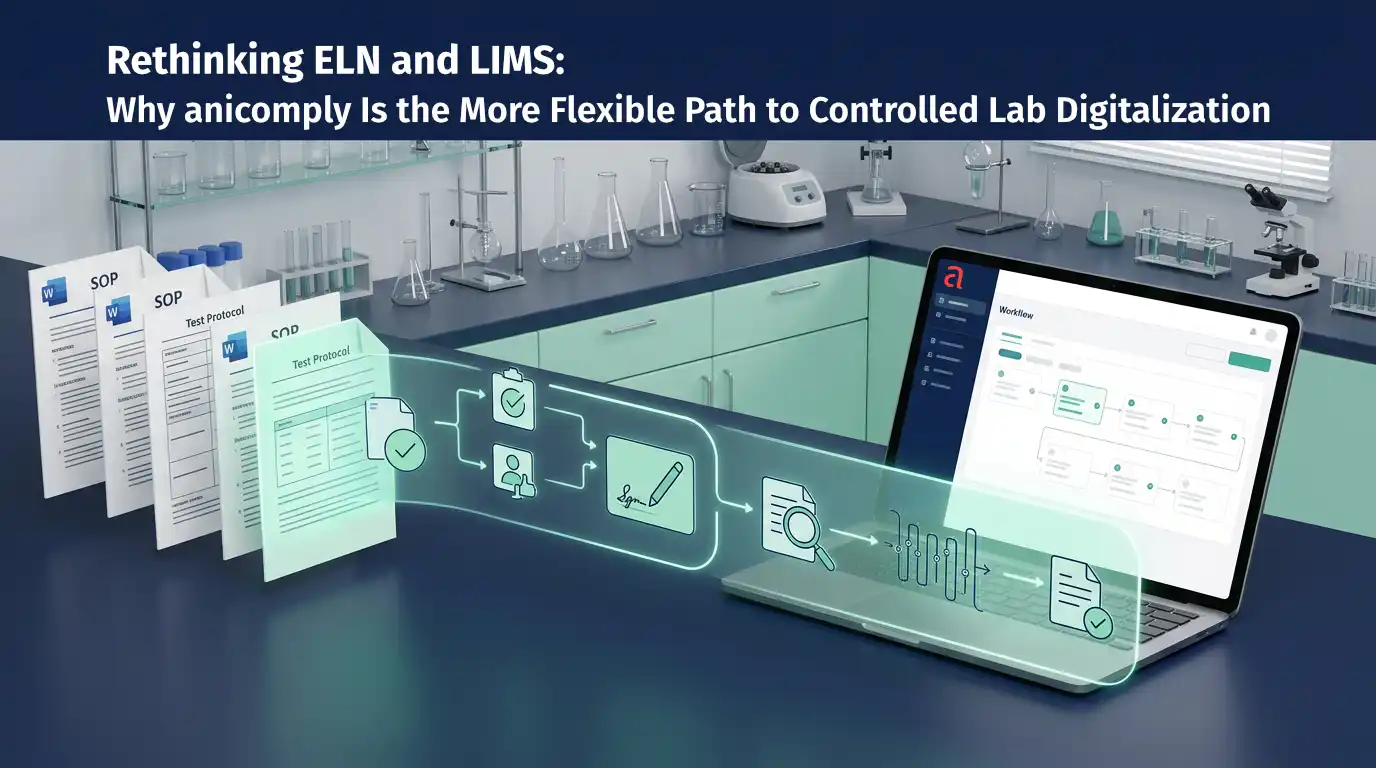
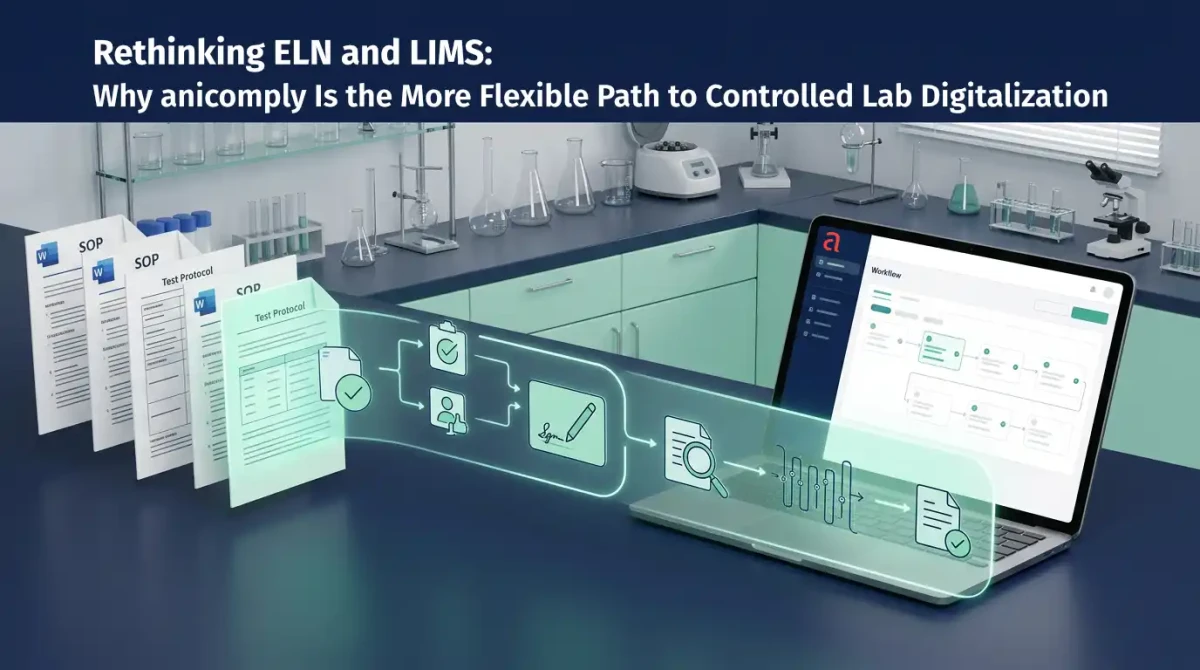
Laboratory managers, IT business partners and technical management know the problem: the SOP is stored in Word, execution happens on paper or in Excel, and every change to a method means weeks of effort — ticketing, vendor coordination and revalidation. Traditional ELN and LIMS systems often adapt processes only slowly and rigidly. What is missing is a system that can directly take over existing Word documents and immediately turn them into executable, controlled workflows.
This is exactly what anicomply does.
Not Another Notebook — Controlled Process Execution
anicomply confidently positions itself as an alternative to traditional ELN, LIMS and eBR systems — not as an additional layer that simply fits into existing system landscapes. The platform was built for highly flexible, regulated laboratory processes and production workflows where speed of change and GxP control are required at the same time.
The decisive difference lies in the starting point: while traditional systems require processes to be rebuilt in proprietary modeling tools, anicomply directly takes over existing Word documents, SOPs and test protocols. Familiar business documents become executable, rule-based workflows — without a large-scale project, without a system break and without abstract rethinking.
What Regulated Laboratory Processes Really Need
In GMP- and GLP-regulated environments, it is not enough to store results digitally. What matters is the chain of control: who performed which step, when, based on which template version, with which justification and under which approval?
In practical terms, this means: audit trail, electronic signatures, versioning, role-based access controls, QA review and review by exception — all within the same controlled context, not distributed across paper, email communication and separate systems.
anicomply natively supports exactly these requirements. Laboratory protocols, method validations, stability studies, in-process controls and SOP-guided routine processes become controllable processes with data, roles, rules and complete evidence.
The Technical Core: Declarative, Document-Centric and Fast to Change
The technical advantage of anicomply lies in its declarative approach. Business processes are described as structured, executable workflows — directly from existing document structures. These workflows run in a validatable, integrated environment where they can be executed, reviewed and approved in a controlled way.
This has a direct operational consequence: when a method changes, a limit value is adjusted or an additional QA step becomes necessary, the adaptation remains within the business domain — without an IT ticket and without vendor escalation. Business departments can prepare and adapt workflows close to the original documents, while execution, signatures, audit trail and approvals remain fully within the controlled system.
Who anicomply Is Especially Relevant For
anicomply addresses organizations that are stuck between paper, traditional ELN/LIMS and a heavy eBR or MES program. Paper is flexible, but weak in terms of data integrity. Large systems provide control, but are often slow when changes are required. anicomply connects both sides.
The platform is particularly strong wherever processes frequently vary: CDMO- and CMO-related laboratory workflows, customer-specific test protocols, analytical method development, stability studies or regulated routine processes with a high pace of change.
At the same time, its capabilities are not limited to one specific segment. anicomply works equally well as an eBR in production environments, as a guided laboratory execution system and as an ELN alternative for document-centric research and QC processes.
Conclusion
anicomply is not a notebook and not another sample management system. It is a platform for regulated process execution — combining the flexibility of a document-based approach with the control of a GxP-validatable environment.
For laboratory managers, IT business partners and technical management, this means: existing SOPs and test protocols become executable, auditable workflows without detours. The process remains manageable — even if it changes tomorrow.
See live how an existing laboratory SOP becomes a controllable GxP workflow.