GitOps transforms infrastructure management by defining the entire desired state in a Git repository and letting the environment update itself automatically. This creates transparency, security, and a self‑healing system that corrects drift on its own. At the same time, GitOps introduces new challenges around configuration and sensitive data. Why the approach is still worth it—and how modern tools make it work in practice—unfolds in the full article.
What does GitOps mean?
GitOps is an approach to infrastructure management where the configuration and state of a target environment (e.g. Kubernetes cluster) are stored in a code repository. This means infrastructure is treated like any other code with version control.
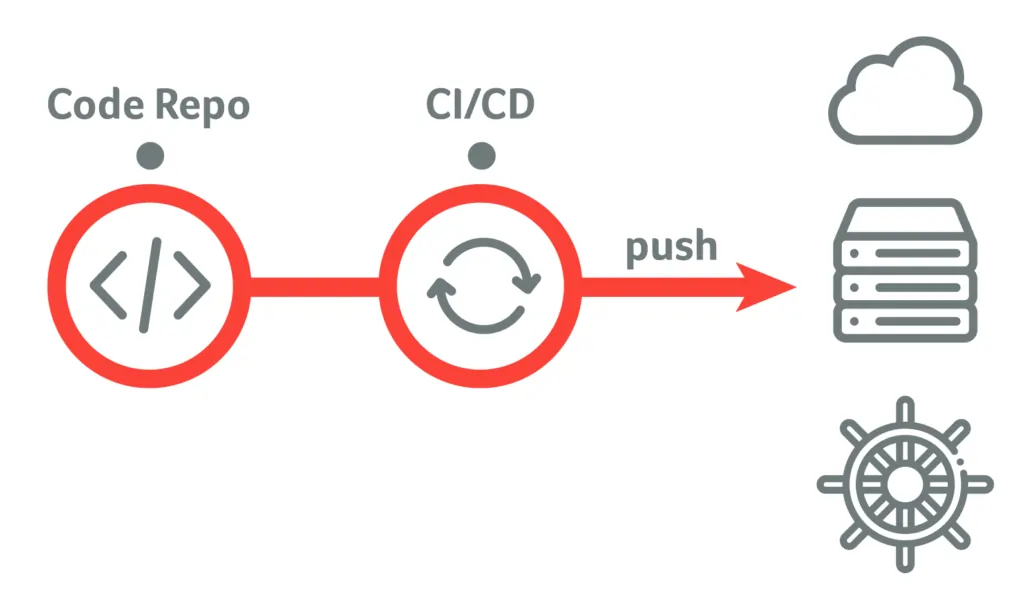
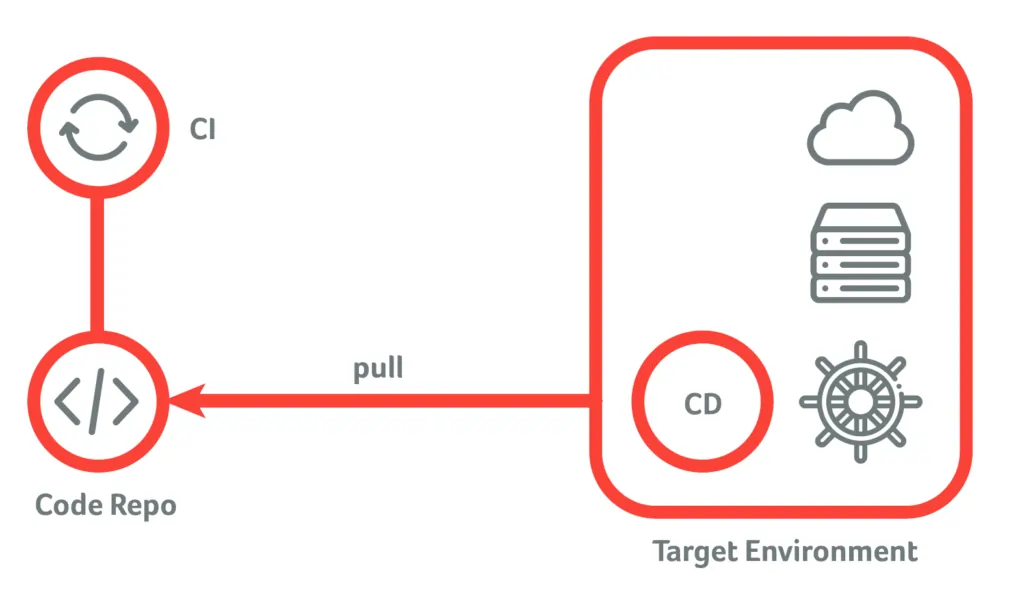
The key difference from traditional approaches is that it's not a CI server that transfers changes to the target environment, but rather the target environment itself monitors the repository and automatically rolls out changes.
What advantages does GitOps offer?
Version Control and Traceability
Changes to the infrastructure are versioned via the repository and are therefore traceable at any time. This also makes it possible to return to an earlier state at any time.
Automated Target-Actual Comparison
The target environment continuously monitors the repository and compares the current state with the desired state in the repository. If deviations are detected, they are automatically corrected. This leads to a "self-healing" effect that automatically reverses manually made changes to the target environment.
Access Control
Since changes are made via the repository, direct access authorization to the target environment is not required. This increases security, as for example a CI server does not need access rights to the target environment and therefore no firewall rules need to be adjusted.
Fast Deployment, Easy Rollbacks
Changes can be deployed quickly and easily via the repository. Rollbacks are also easy to perform, as only an earlier version of the repository needs to be checked out.
What challenges need to be mastered?
Faulty configurations can lead to the target environment being put into an undesired state. It is therefore important that changes are carefully tested before being adopted into the repository.
Another aspect is the handling of sensitive data such as passwords or certificates. These should not be stored in plain text in the repository. There are various solutions for this, such as encrypted secrets.
Getting started with GitOps also requires a certain learning curve, as new tools and concepts need to be learned.
How we make GitOps successful
We use GitOps for managing our Kubernetes clusters. For this, we rely on Flux CD, an open-source tool that handles repository monitoring and automatic rollout of changes.
For managing sensitive data, we use Sealed Secrets, a tool that allows secrets to be stored encrypted in the repository. These are then decrypted at runtime in the target environment. This way, authorization tokens can also be securely stored in the repository.
Would you like to learn more about GitOps or need support with implementation? Contact us!