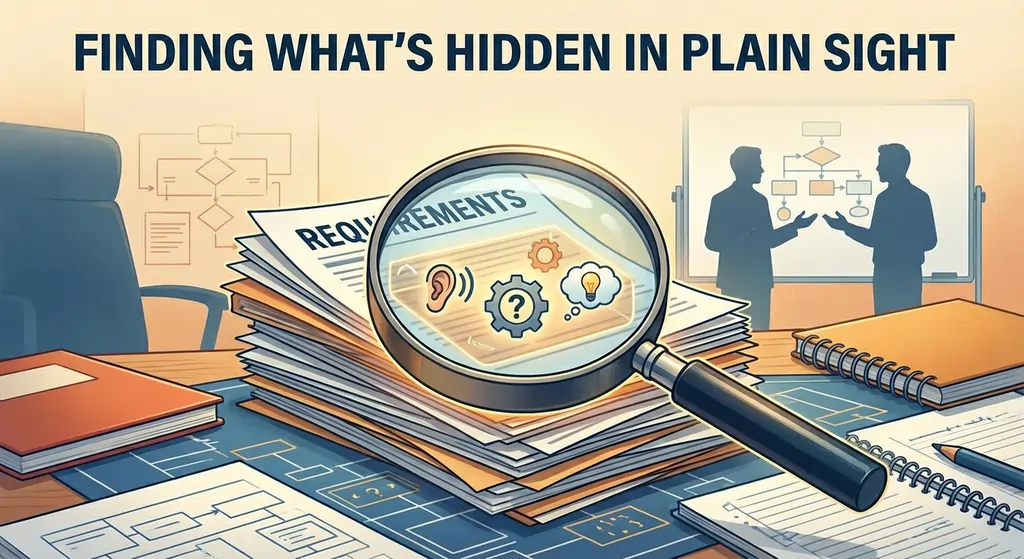
Finding What's Hidden in Plain Sight – How to Get High-Quality Requirements
Categories
I was recently asked by a customer how to improve the requirements collection process. The answer lies in a systematic approach – and the ability to uncover unstated requirements.
Note: This is the English version of the article, originally published on LinkedIn.
I was recently asked by a customer how to improve the requirements collection process.
What I've experienced repeatedly for over 20 years is high-level RM without the necessary details, which then have to be laboriously "discovered" retroactively during implementation, followed by surprise and change request upon change request as what was supposedly requested wasn't delivered.
The very good starting point is the PMI® publication: Business Analysis for Practitioners: A Practice Guide – Second Edition. Describing and breaking down the RM process into a well defined process with clear ownership.
A definitive prerequisite equally important as fundamental to success is management buy-in for sensible Requirements Management (RM).
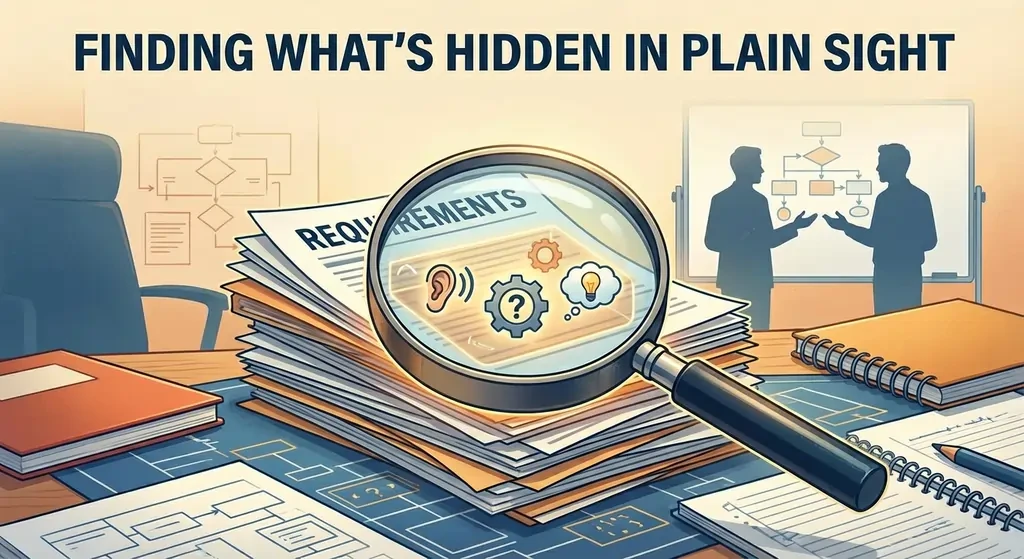
Successful RM is essentially characterized by the ability to listen well, to uncover unstated requirements by asking the right questions, and the ability to put oneself in others' shoes and understand their processes.
And it certainly is always a good idea to document the elicited requirements.
The best results I've achieved so far have been by imparting fundamental knowledge about RM and accompanying the further process through coaching and mentoring, while the analysts "experience" how the behavior outlined above has a positive impact.
As proper requirements management is tacit knowledge - that is, experiential knowledge - it must be worked for.
Conclusion
Successful requirements elicitation is not a one-time activity, but a continuous process of learning and improvement. The combination of systematic approaches based on proven frameworks like the PMI Business Analysis Practice Guide and the development of "soft" skills – active listening, empathy, and the art of asking the right questions – makes the difference between superficial requirements gathering and true Requirements Management.